Is the Brazilian Championship getting more unfair? (FINAL UPDATE)
Introduction
As the Brazilian Championship (Brasileirão) officially ended this Sunday with Flamengo as champion and all rounds completed, let’s once again ask the same question I started in my post: “Is the Brazilian Championship getting more unfair?”
Once again, I went to Wikipedia and updated the data, now including the year 2019.
Is structural inequality in the Brazilian Championship a trend?
In the first analysis conducted here on the blog, I reached the conclusion that “Yes. Using the Gini Coefficient as a metric to measure whether there is structural inequality showed that there are indeed latent elements of this inequality“.
Given the exceptional campaign of Flamengo, which not only broke the record for the number of points in a single edition but also, if we consider only away games, Flamengo still would not be relegated (19 games - 11w 4d 4l) (Source: Tiago Vinhoza).
But since we are talking here about the variance of the distribution of points within this edition of the Brasileirão, a fact pointed out by @Impedimento was that this edition had the lowest score effectively achieved by a team that saved itself: 39 (Ceará), while only 37 were needed to be safe. Or as Tiago Vinhoza said, a strategy of only draws in all games would already be enough to be safe.
Without further ado, let’s run the same scripts now with the updated data.
Inequality ranking among all editions of the Brasileirão using the Gini Coefficient
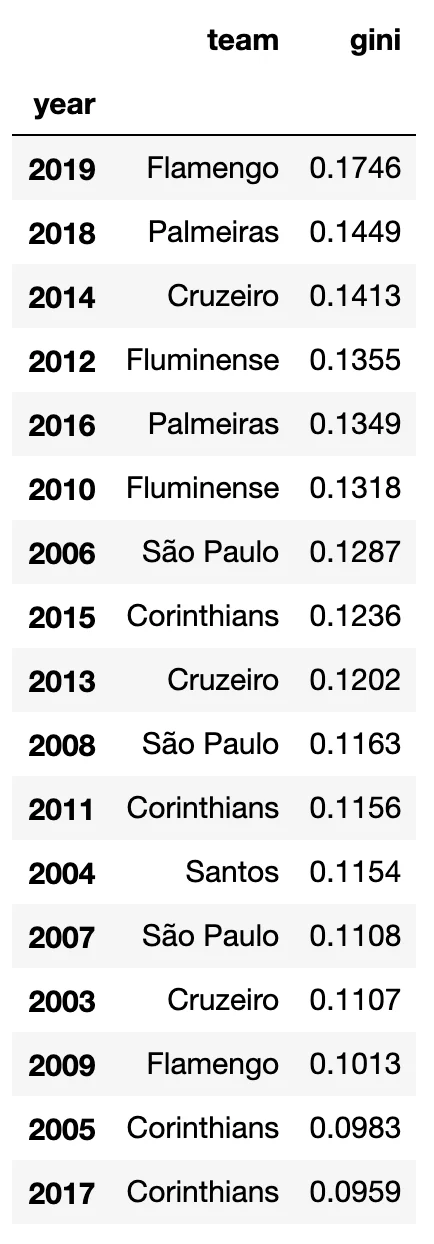
Unlike our last analysis where the 2018 edition (Palmeiras champion) was the most unequal until then, this edition with Flamengo as Champion had a 17% increase ((1 - (0.1449/0.1746)) x 100) in inequality regarding the number of points compared to 2018, which shows that the trend of this inequality is here to stay.
As we did previously, let’s look calmly at this 2019 edition to verify some interesting facts:
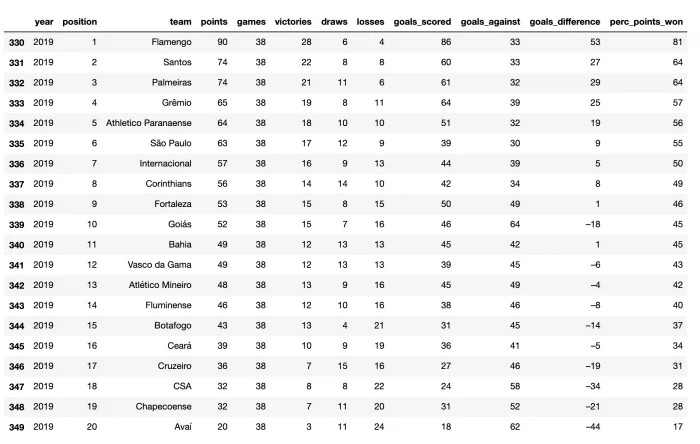
Following the pattern of our last analysis, let’s look at some points of the final table:
- Flamengo finally broke the impressive barrier of 90 points in a 20-team championship; which, for comparison purposes, is the same number of points that Real Madrid and/or Barcelona make in overwhelming seasons in the Spanish League which indicates that there was a very large disparity on the field;
- As already mentioned above, a strategy of only draws (38 points) would already be enough to escape relegation;
- Avaí was the punching bag of this Brasileirão, conceding 72 points (24 * 3) along the table to numerous teams, and lost 22 points in draws (or took them from other teams). In addition to Avaí, we had 3 more teams with more than 20 defeats (CSA, Chapecoense, and Botafogo has 19) which possibly contributed to this inequality of points.
- We actually had 4 Championships: Championship 1 which I would call “Flamengo’s Stroll”; Championship 2 which would be “Fight for the Runner-up starring Santos and Palmeiras”; Championship 3 “Spots for Libertadores and Sudamericana”; and the last championship (4) which would be “Who will be relegated with CSA, Chape, and Avaí?”; and
- Between the 7th placed (Internacional) and the penultimate placed (Chapecoense), the largest point difference was 4 points between teams in sequence (e.g. 15th to 16th).
In general terms, what we can see is that we had some blocks of teams with a certain number of points, but the bulk of all points went to the top teams, especially the Champion and the two runners-up.
Let’s now look at the evolution of this inequality over time and compare it with previous editions.
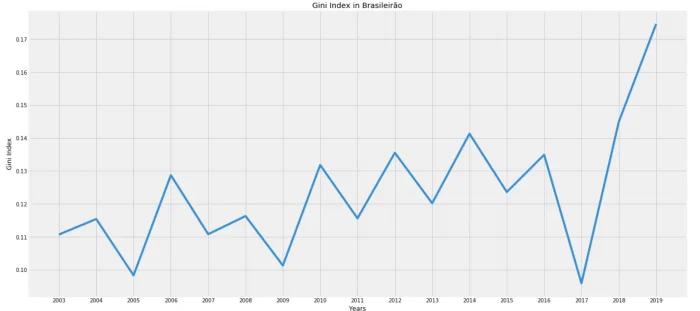
In my last analysis, I had made the following consideration:
“Something surprising is that the valleys usually happen in odd years and the peaks in even years. This might be explained by some external effect, such as the Olympics and World Cup that occur in even years. It’s a very weak hypothesis, but it’s still a hypothesis.”
In other words: This year’s Brasileirão not only showed that this was a hypothesis that no longer makes sense but now shows that it is an outlier among all editions of the round-robin system, in terms of team inequality.
To smooth this effect a bit, let’s consider, following the previous post, only a moving average considering a 3-year lookback.
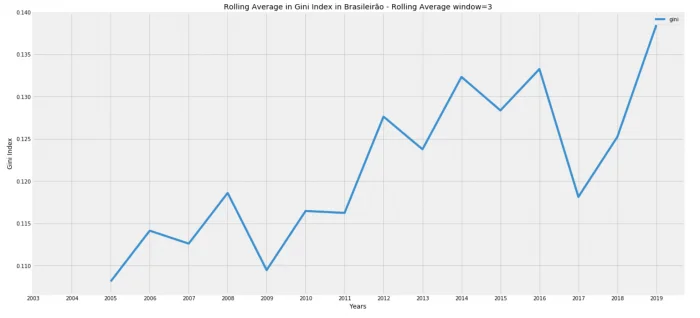
Looking more closely, we can even think of the hypothesis that It was not the year 2019 that was an outlier, but the years 2017 and 2009 that are the true outliers regarding inequality.
Following the pattern of the previous post, let’s remove the champion and the worst team from all seasons and recalculate again.

Even removing Avaí (worst team) and the Champion (Flamengo), the 2019 championship still remains the most unequal of all time.
Let’s generate the chart just to verify if the trend of increasing inequality remains or not.
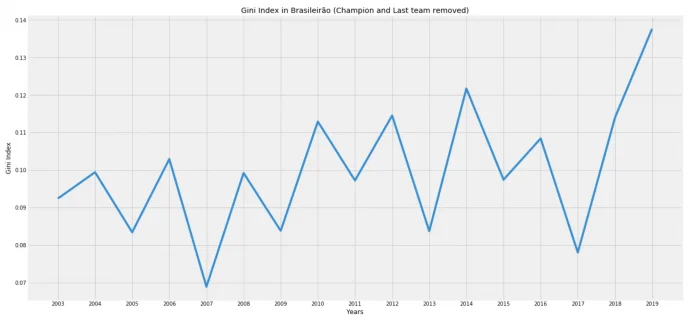
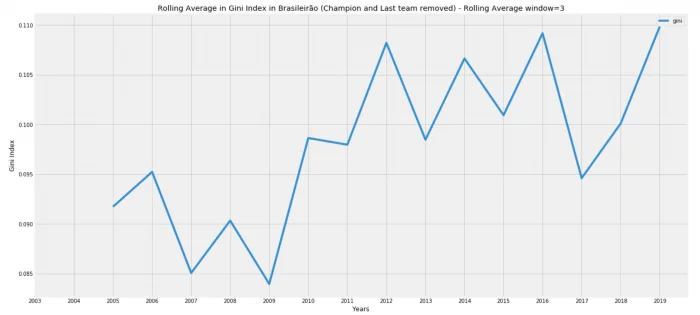
Looking at the Gini Coefficient while removing the champion and the worst team, we can see that we still have the trend of increasing inequality within the league.
Final Considerations
If we have to answer our main question, which was “Is the Brasileirão getting more unfair over time?” the answer would be:
“Yes. There is structural inequality in the Brazilian Championship with an upward trend, and the 2019 edition was the most unequal of all.”
Here I will take the liberty of making some considerations regarding what I think might be happening in the Championship:
- Financial disparity is a reality. Palmeiras, which is one of the clubs that invests the most money, has been champion 2 times, runner-up, and 3rd placed in the last years. Flamengo, which made investments in the order of more than 100 million reais, showed that spending is the name of the game;
- With this arms race regarding money and its role in the league, what will happen is that investments will have to be precise because the risk of revenue and title frustration is very large, given that the champion earns in money the equivalent of only 6 months of salaries. In other words, those who are not champions run the real risk of taking massive losses;
- Given what was stated above, I think Superteams are here to stay and all other teams that will just be competing for spots in continental competitions will be much more prudent in signings. In other words: If you’re not going to be champion, invest only enough to take the team to some championship that has knockout games, these are the ones that increase the chances of being champion even with non-millionaire squads as Athletico Paranaense has already shown, winning a Copa Sudamericana and a Copa do Brasil in 2 years.
Inspired by an interaction I had on Twitter with Tiago Vinhoza - @tiagotvv, I will collect data from European leagues since the 90s and analyze if this inequality happens in other leagues in the world and compare it with the Brazilian league.
As always, the data and code are on GitHub.
References and useful links
Inequality in the Premier League - Çınar Baymul
An Analysis Of Parity Levels In Soccer - Harvard Sports
Which Sports League has the Most Parity? - Harvard Sports
Major League Soccer and the Effect of Egalitarianism - Harvard Sports
Mourão, P. R., & Teixeira, J. S. (2015). Gini playing soccer. Applied Economics, 47(49), 5229-5246